


 Language
 English
 русский
 Español
 Português
 Deutsch
 عربى
عربى italiano
 Türk
Türk हिंदी
हिंदी Indonesia
 Tiếng Việt
If you need any help, please feel free to contact us

Cable Trays Explained: Types, Uses & Standard Sizes
Content
Quick answers: A cable tray is an open, rigid support system used to route and organise electrical cables in buildings and industrial facilities — replacing conduit in most large-scale installations. The three main types are ladder tray, perforated (solid-bottom) tray, and wire mesh tray. Standard widths run from 50 mm to 900 mm; standard lengths are 3 m per section. Material is typically hot-dip galvanised steel, stainless steel, or fibreglass depending on the environment.
What are cable trays in electrical installations?
A cable tray is a factory-made, rigid support structure — open at the top — designed to carry and organise groups of electrical cables along a defined route through a building or facility. Unlike conduit, which encloses cables inside a sealed tube, a cable tray leaves cables accessible from above at any point along its length. This accessibility is one of its most important practical advantages: cables can be added, removed, or rerouted without dismantling the support system.
Cable trays are governed by standards including NEMA VE 1 (USA), IEC 61537 (international), and BS EN 61537 (UK/Europe). These standards define load ratings, dimensions, test methods, and material requirements to ensure that a tray rated for a given load and environment actually performs as specified in service.
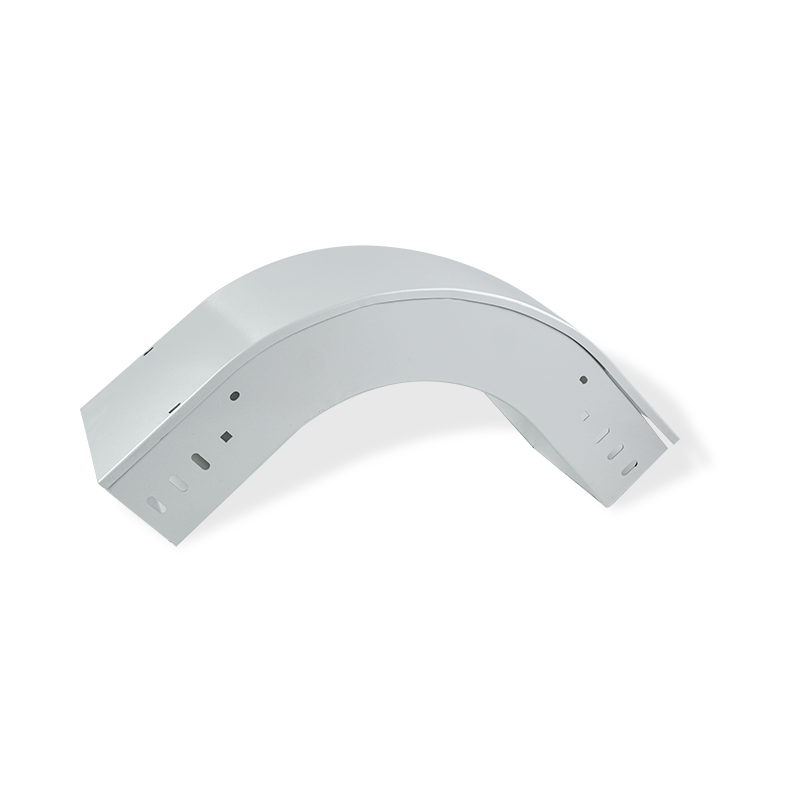
The term "cable tray system" refers to the full assembly: the tray sections themselves, plus the fittings that allow direction changes (horizontal and vertical bends, tees, crosses), the supports that suspend or wall-mount the tray, and the covers used where mechanical protection or EMI shielding is needed.
Cable trays should not be confused with cable ducting (fully enclosed rectangular channels, typically used for smaller cables in office environments) or cable ladders (a heavier variant of the ladder-type tray, designed for very heavy cables in industrial settings — the distinction between ladder tray and cable ladder is partly one of load capacity and rail depth).
What are cable trays used for?
Cable trays are the primary cable management solution in virtually every large commercial, industrial, and infrastructure project. Their specific applications span a wide range of sectors and cable types.
Power distribution cables
The most common use is carrying medium and large power cables — typically 16 mm² to 400 mm² cross-section — from switchgear and distribution boards to plant and equipment. In a commercial office building, these are the cables running above suspended ceilings from the main LV switchroom to floor-level distribution boards. In a data centre, they carry high-density power feeds to server rows. Ladder trays are preferred for heavy power cables because the open rungs allow air circulation around cable jackets, preventing heat build-up that would otherwise require the cable to be derated.
Telecommunications and data cabling
Separate trays — usually wire mesh or perforated types — are run for structured cabling (Cat 6, Cat 6A, fibre optic). Data cables are kept physically separated from power cables to avoid electromagnetic interference (EMI). A standard approach in large buildings is to run power trays and data trays in parallel at different heights or on opposite sides of a corridor, with a minimum separation of 200 mm for unshielded data cables where mains voltage is carried in the power tray.
Industrial and process facilities
Refineries, chemical plants, and manufacturing facilities rely heavily on cable trays to manage instrument cables, control cables, and heavy power feeds simultaneously. In these environments, tray systems can run for hundreds of metres along pipe racks at heights of 4–10 m. Hot-dip galvanised steel trays are standard; in corrosive environments (coastal, chemical, or food-processing facilities), either stainless steel (316L grade) or glass-reinforced plastic (GRP/fibreglass) trays are specified.
Overhead vs. underfloor installations
While ceiling-level overhead installations are most common, raised-floor environments — particularly data centres and trading floors — use cable trays beneath the floor to route power and data cables to individual floor tiles. In these installations, the tray is typically inverted or a wire mesh type is used to allow maximum airflow under the raised floor.
What are the 3 main types of cable tray?
The three types differ primarily in their base construction, which determines the cable sizes they support best, the environments they suit, and how much ventilation they provide around cables.
1. Ladder tray
Ladder tray consists of two parallel side rails connected by rungs spaced at regular intervals — typically 150 mm, 225 mm, or 300 mm. This construction is the most open of the three types, providing maximum air circulation and making it easy to see and access individual cables at any point along the run.
Ladder tray is the preferred choice for:
- Heavy power cables (large cross-section cables need support at rung intervals to avoid sagging, and need ventilation to shed heat)
- Long horizontal runs in industrial facilities
- Installations where cable identification and future changes are frequent priorities
Rung spacing matters for cable support. IEC 61537 recommends that cables with an outer diameter of less than 9 mm should not be carried on ladder trays with 300 mm rung spacing, as small cables can sag between rungs and be damaged. For small cables, closer rung spacing (150 mm) or a different tray type is more appropriate.
2. Perforated (solid-bottom) tray
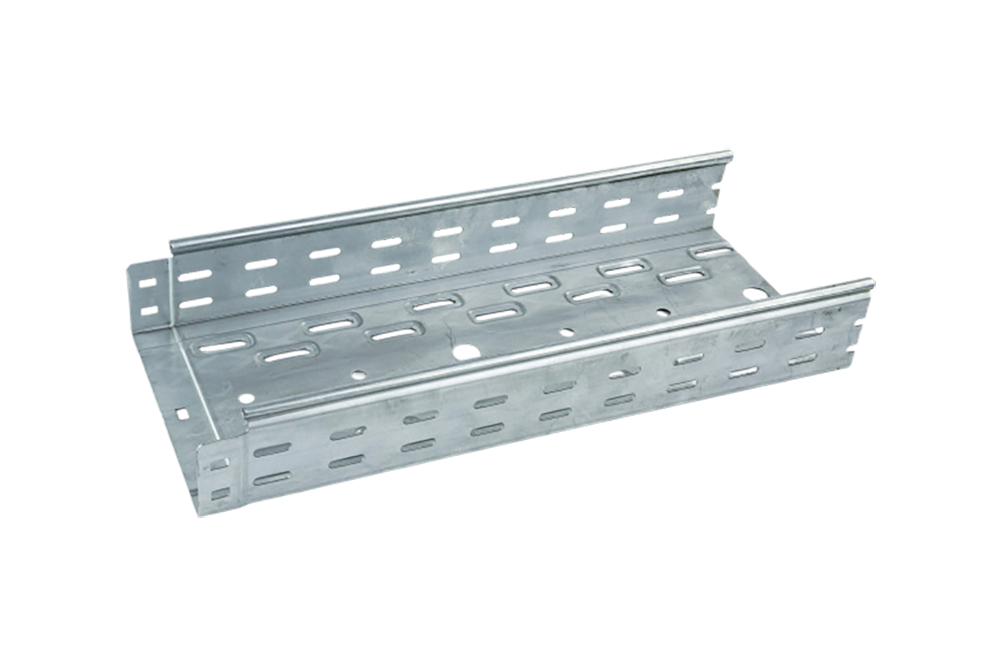
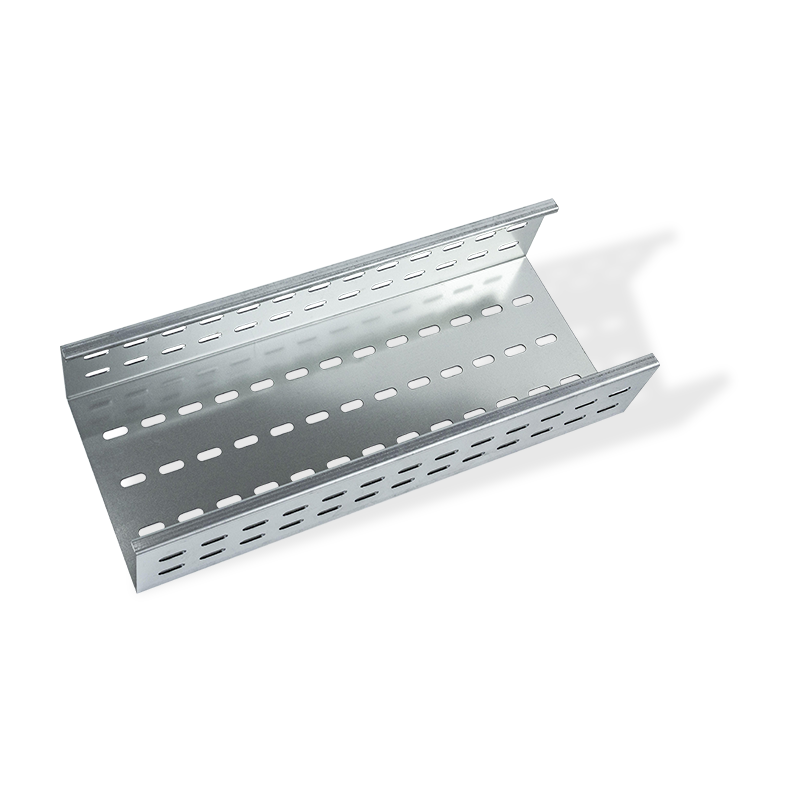
Perforated tray has a continuous flat base with punched holes — typically 10–30% open area — flanked by solid or slightly raised side rails. It is often called "solid-bottom" tray in the USA, though strictly a solid-bottom tray has no perforations at all (used where drip protection is needed). In common usage, "perforated tray" describes the punched-base type.
The perforated base supports cables of all sizes without sagging risk, making it well-suited for:
- Small and medium power cables
- Instrument and control cables that need full support along their length
- Mixed cable installations where both large and small cables share the same tray
- Areas where some degree of dust or drip protection is desirable
Ventilation is lower than ladder tray, so larger power cables may need to be derated if fully buried in a deep layer of cables. NEC 392.80 (USA) and IEC 60364-5-52 provide derating factors based on the number of cable layers and tray fill percentage.
3. Wire mesh tray (cable basket)
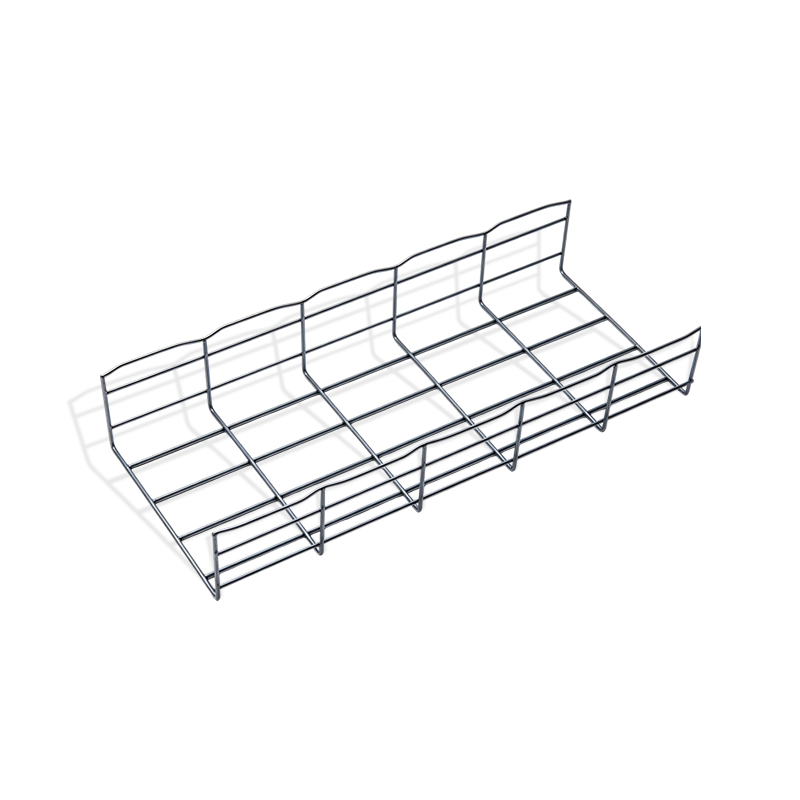
Wire mesh tray — also called a cable basket or wire basket tray — is fabricated from welded steel wire rather than formed sheet metal. It is extremely lightweight, flexible enough to accommodate minor site deviations without cutting, and fast to install. A wire mesh tray can be bent by hand on site to create gentle curves or angle changes that would otherwise require a factory fitting.
Wire mesh tray is the dominant choice for:
- Data centres and IT rooms — lightweight, allows maximum airflow, easy to reconfigure
- Office buildings and commercial interiors — neat appearance, easy installation above suspended ceilings
- Structured cabling (Cat 5e through Cat 8, fibre optic) where flexibility and low weight matter more than high load capacity
Load capacity is significantly lower than ladder or perforated tray. Most wire mesh systems are rated for 15–50 kg/m, compared to 50–300 kg/m for heavy ladder tray. Wire mesh tray is not appropriate for large power cables.
| Feature | Ladder tray | Perforated tray | Wire mesh tray |
|---|---|---|---|
| Construction | Rails + spaced rungs | Solid/punched base + rails | Welded wire grid |
| Best for | Heavy power cables | Mixed / small cables | Data / structured cabling |
| Load capacity | Up to 300+ kg/m | Up to 150 kg/m | 15–50 kg/m |
| Ventilation | Excellent | Moderate | Good |
| Installation speed | Moderate | Moderate | Fast |
| On-site adjustability | Low (requires fittings) | Low (requires fittings) | High (can be bent by hand) |
| Typical material | Galvanised steel, SS | Galvanised steel, GRP | Galvanised steel, SS |
What are the standard cable tray sizes?
Cable trays are manufactured to standardised dimensions to allow components from different suppliers to be combined on a project and to give engineers predictable performance data for load calculations. The key dimensions are width, depth (side rail height), and section length.
Standard widths
Width is the most important dimension for capacity planning — it determines how many cables can be installed side by side. Standard widths under IEC 61537 and most national equivalents are:
| Standard width | Typical application |
|---|---|
| 50 mm (2 in) | Small instrument runs, single cable routes |
| 100 mm (4 in) | Light data cabling, small branch runs |
| 150 mm (6 in) | Small power and data runs |
| 200 mm (8 in) | Medium power distribution, mixed cables |
| 300 mm (12 in) | Large power runs, main distribution routes |
| 450 mm (18 in) | High-density installations, industrial main runs |
| 600 mm (24 in) | Major distribution routes, data centre power |
| 750 mm (30 in) | Large industrial facilities, primary cable highways |
| 900 mm (36 in) | Maximum standard width, heavy industrial |
Standard depths (side rail heights)
Depth — the height of the side rails — determines how many cable layers can be stacked and contributes to the tray's structural rigidity and load-spanning capability. Common depths are:
- 25 mm (1 in) — shallow, used for light data and instrument cables
- 50 mm (2 in) — the most common general-purpose depth
- 75 mm (3 in) — medium-duty power and mixed installations
- 100 mm (4 in) — heavy-duty power, where multiple large cable layers are stacked
- 150 mm (6 in) — specialist heavy industrial applications
Deeper trays are stiffer and can span greater distances between supports. A 300 mm wide × 100 mm deep galvanised steel ladder tray in a medium gauge can typically span 3 m between supports at rated load, whereas a 300 mm × 50 mm tray of the same material may require supports at 1.5–2 m intervals to stay within deflection limits.
Standard section lengths
Nearly all cable tray is manufactured in 3-metre sections (approximately 10 feet in the USA). Some manufacturers also offer 6-metre sections for large industrial projects where fewer joins are desirable. Wire mesh tray is typically supplied in rolls of 15–30 m for continuous runs, cut to length on site.
Tray fill and capacity rules
Selecting a tray width is not simply a matter of measuring the cables and choosing the nearest size. Standards and good engineering practice require that the tray not be overfilled, for two reasons: heat dissipation and future capacity. The common rules are:
- NEC 392.22 (USA): For ladder and ventilated trays carrying multiconductor cables, the sum of the cross-sectional areas of all cables must not exceed the permitted fill area — for a 300 mm wide tray, this is 1.5 in² per 75 mm of usable width (approximately 4,500 mm² of cable cross-section for a 300 mm tray).
- IEC 61537: Specifies a maximum fill ratio of typically 40–50% of the internal tray cross-section to allow for heat dissipation and future additions.
- Practical rule of thumb: Plan for no more than 40% fill at installation, leaving 60% for future cable additions. Projects that fill trays to 80–90% at handover regularly require expensive tray upgrades within 5 years as systems are expanded.
Material options and when to use each
The tray type and size tell you the form and capacity; the material tells you the environment the tray can survive in.
| Material | Best environment | Key properties | Relative cost |
|---|---|---|---|
| Hot-dip galvanised steel | Indoor, standard industrial | High strength, good corrosion resistance, earthing continuity | Low–medium |
| Pre-galvanised (electro-zinc) steel | Dry indoor environments | Lighter zinc coating, lower cost, not for wet areas | Low |
| Stainless steel (304 / 316L) | Coastal, food-processing, pharmaceutical | Excellent corrosion resistance, 316L for chloride exposure | High |
| Aluminium | Lightweight applications, some corrosive environments | Light, non-magnetic, not suitable where high mechanical loads occur | Medium |
| GRP / fibreglass | Chemical plants, offshore, highly corrosive areas | Non-conductive, chemically resistant, no earthing continuity | High |
| PVC-coated steel | Mildly corrosive or aesthetic-sensitive indoor | Coloured finishes available, limited chemical resistance | Medium |
One practical point on GRP trays: because they are electrically non-conductive, they cannot form part of the protective earthing system. Separate earth continuity conductors must be installed alongside GRP trays in any installation where metallic tray would otherwise have served as the earth path — this is a common oversight that creates compliance failures on inspection.

Youming Group is a manufacturing group company mainly engaged in the research and development of new high-strength cable tray
Product
- Wire Type Cable Tray Series
- Punched Type Cable Tray Series
- Trough Type Cable Tray Series
- Cable Rack Ladder Series
- Ladder Type Cable Tray Series
- Marine Cable Ladder Tray
- Strut Channel Cable Tray Series
- Accessories
- Fiber Cable Tray/Optic Cable Tray
- Photovoltaic Stents
- Stainless Steel Cable Tray Series
- Aluminum Alloy Cable Tray System
Contact information
-
No.36, Taidong Industrial Zone Shiyan Town, Dongtai City, Jiangsu Province
