


 Language
 English
 русский
 Español
 Português
 Deutsch
 عربى
عربى italiano
 Türk
Türk हिंदी
हिंदी Indonesia
 Tiếng Việt
If you need any help, please feel free to contact us

Ultimate Cable Tray Guide: Types, Fittings, Supports & NEC Rules
Content
- 1 Are Cable Trays Raceways? The Technical and Legal Distinction
- 2 What Are the Types of Cable Tray? Structural Designs Explained
- 3 What Are Cable Tray Fittings? Mechanical Routing Components
- 4 What Are Cable Tray Supports? Structural Anchoring Methods
- 5 Common Professional Questions Regarding Cable Trays
Quick Summary
A professional cable tray system is a rigid structural framework used to securely support, route, and protect electrical cables and conductors in commercial and industrial environments. According to the National Electrical Code (NEC) Article 392, a cable tray is legally defined as a structural support system and not a raceway. Unlike enclosed raceways, cable trays function as an open bridging infrastructure, allowing safe heat dissipation for power cables, facilitating straightforward circuit alterations, and providing exceptional mechanical safety across complex spans without requiring dedicated conduit pull boxes.
Are Cable Trays Raceways? The Technical and Legal Distinction
In electrical engineering design, confusing a cable tray with a raceway is a critical compliance error. By regulatory definitions under the NEC and NEMA, a raceway is an enclosed channel (such as rigid metal conduit, EMT, or electrical metallic tubing) explicitly designed to enclose individual wires or wrapped cables. Wires within a raceway must be pulled through the system using pulling lubricants and specialized junction points.
Conversely, a cable tray acts as a supportive mechanical bridge. Because it is an open structure rather than an enclosed channel, you can lay conductors directly into the tray along its entire run. This open-air configuration significantly alters electrical engineering physics. Conductors operating in open air do not suffer from severe heat accumulation. Consequently, under NEC ampacity adjustment rules, cables arranged in a ventilated tray can carry higher electrical currents than identical conductors confined inside a closed raceway channel.
What Are the Types of Cable Tray? Structural Designs Explained
Selecting the appropriate structural configuration depends entirely on the mechanical load, the type of cables deployed, and the environmental conditions of the installation site.
Ladder Cable Trays
Consisting of two longitudinal side rails connected by individual transverse rungs spaced at regular intervals (typically 225mm to 300mm), ladder trays account for the vast majority of industrial installations. This design provides maximum ventilation, preventing heat buildup in high-voltage power distribution lines. The rungs serve as durable mechanical anchor points, allowing installers to secure heavy cables easily with zip ties or cleats along vertical or horizontal paths.
Solid Bottom Cable Trays
This configuration features a completely non-ventilated solid metal sheet floor beneath the cable run. Solid bottom trays are specified for delicate fiber optic networks or low-voltage control circuits that require absolute electromagnetic shielding or continuous physical protection against falling debris, hot dust, or moisture drip lines.
Trough and Wire Mesh Trays
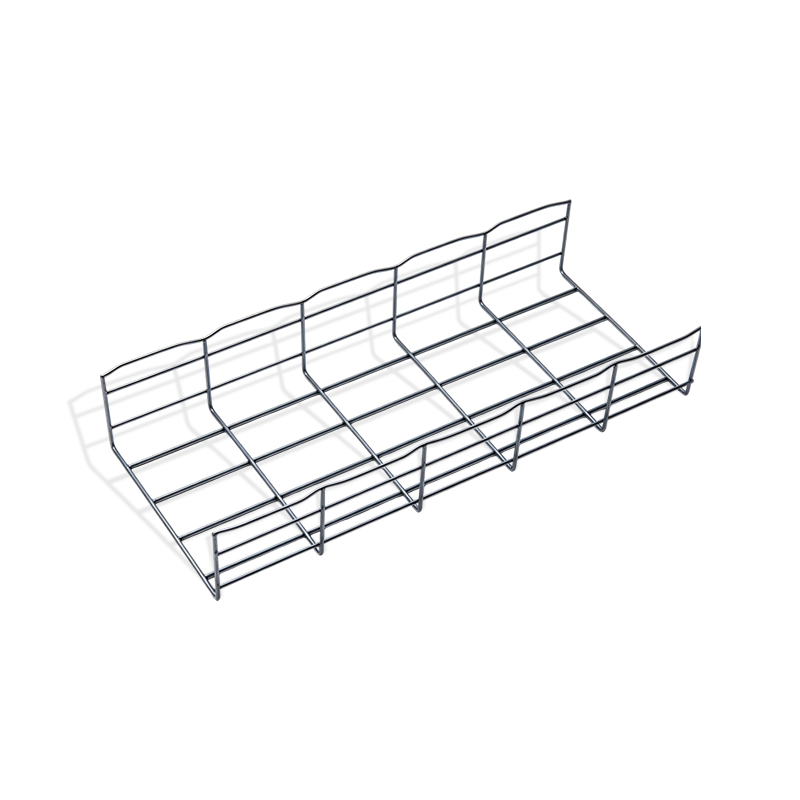
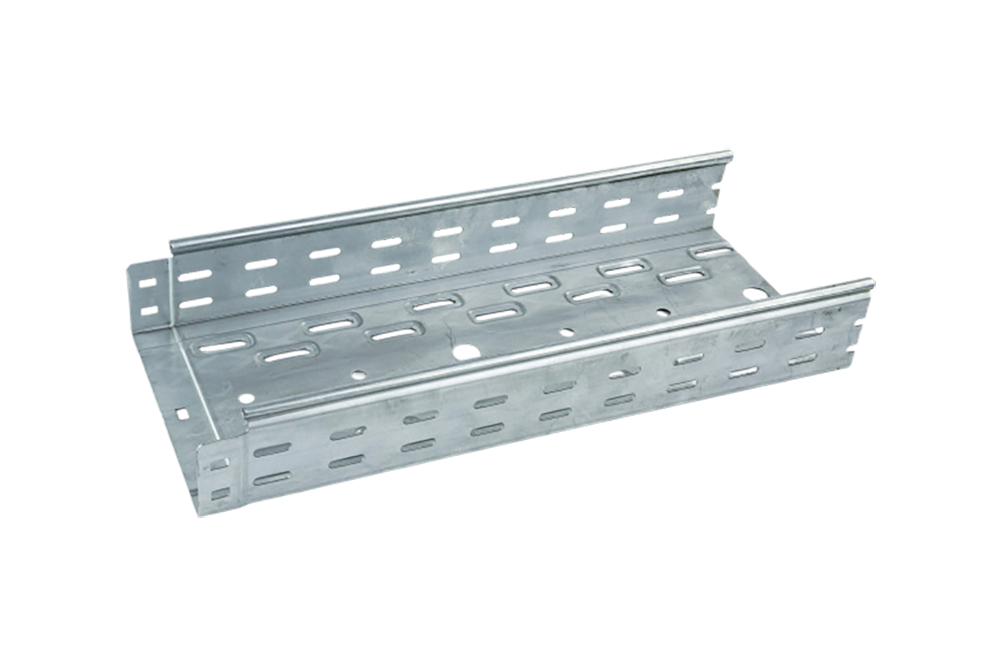
Trough systems feature a ventilated sheet metal profile with pre-punched slots in the bottom, balancing reliable physical support with moderate ventilation. Wire mesh configurations, often called basket trays, are constructed from a welded grid of high-tensility steel wires. Basket trays are lightweight, highly flexible, and can be easily cut and bent on-site to navigate tight architectural geometries. They are universally deployed for high-density data centers, Ethernet routing, and complex instrumentation lines.
| Tray Geometry | Standard Ventilation Level | Recommended Application Fields |
|---|---|---|
| Ladder Tray | High Ventilation (100% air flow) | Heavy industrial power, oil & gas, high-voltage lines. |
| Solid Bottom | Zero Ventilation (Fully enclosed) | Critical control wiring, heavy EMI shielding zones. |
| Wire Mesh Basket | Medium-High Ventilation | Data centers, telecommunications, commercial fit-outs. |
| Perforated Trough | Moderate Ventilation (Slotted base) | Commercial building corridors, light industrial machinery. |
Table 1: Technical application matrix comparing the core structural classes of trays.
What Are Cable Tray Fittings? Mechanical Routing Components
Cable tray fittings are specialized mechanical components used to safely redirect, split, change elevations, or terminate a continuous tray assembly run. Because large-diameter electrical cables possess rigid minimum bending radii, fittings must be engineered with gradual geometric curves to prevent kinking or cracking the protective insulation layers of the conductors.
Standard configuration fittings include:
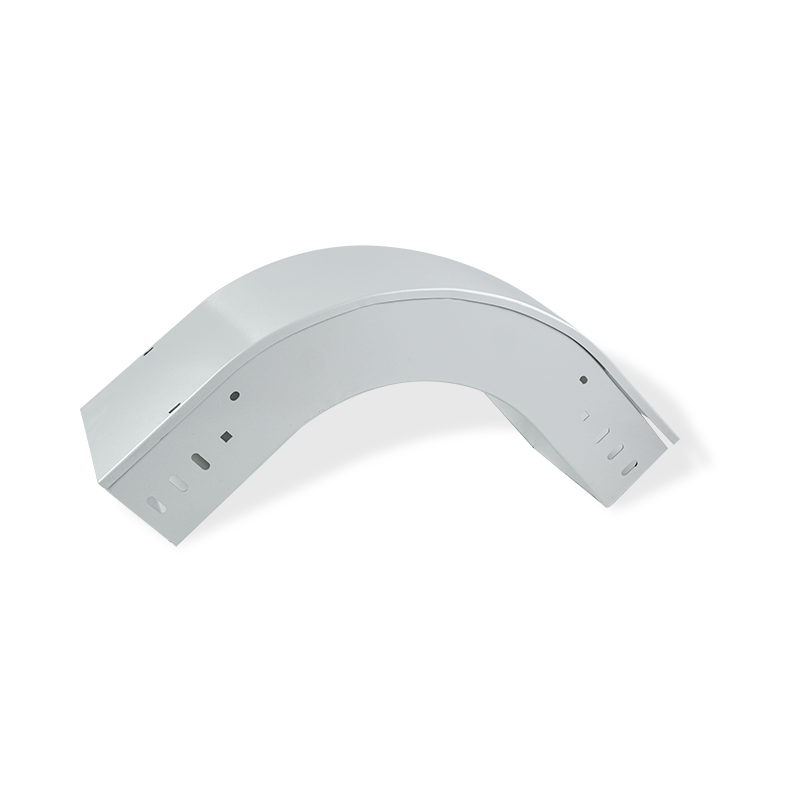
- Horizontal Elbows: Mechanical junctions that alter the horizontal routing plane of the run by 45 degrees or 90 degrees.
- Tees and Crosses: Splitting intersections that allow a single primary distribution pathway to branch off into perpendicular directions across a factory floor or building grid.
- Vertical Bends: Specialized inside or outside vertical fittings used to smoothly shift a horizontal tray run over or under structural beams, ductwork, or architectural barriers.
- Reducers: Splicing transitions that smoothly adjust the total width of the tray system down when a significant portion of the cables have dropped off to feed machinery.
What Are Cable Tray Supports? Structural Anchoring Methods
A tray system is only as reliable as its anchoring infrastructure. Supports are the structural hardware assemblies that transfer the combined dead weight of the metal trays and heavy copper cabling to the structural framework of the facility. These supports must comply with strict deflection metrics specified by NEMA VE-2.
Trapeze
Trapeze Support Configuration
The standard option for overhead ceiling installations. This system utilizes a horizontal structural metal strut channel suspended by two threaded steel rods attached to the overhead building structure. The tray rests perfectly flat across the strut and is locked down with hold-down clamps. It provides excellent stability and easily supports multi-tier tray installations on a single rod drop.
Cantilever
Cantilever Wall Bracket Support
When overhead ceiling access is blocked by ventilation ducting or structural limitations, cantilever brackets are specified. These heavy-gauge steel brackets are bolted directly into structural concrete walls or steel columns, projecting outward horizontally. The tray is secured directly to the upper flange of the bracket, creating a clean lateral pathway along a utility corridor.
Center
Center-Hung Hanger Systems
This single-point system utilizes a single central threaded rod dropped from the ceiling ceiling slab, connecting to a specialized internal bracket underneath the tray profile. This arrangement leaves both outer edges of the tray open and unhindered by side rods, allowing installers to lay new electrical circuits in place without needing to weave cables through supporting structural rods.
Engineering Installation Rule: Support span intervals are strictly determined by the NEMA load class rating. A typical commercial system requires solid support anchorage placements every 1.5 meters to 3.0 meters (5 to 10 feet). Heavy industrial long-span installations can extend structural gaps up to 6.0 meters (20 feet) by employing heavy-gauge deep aluminum side-rail configurations.
Common Professional Questions Regarding Cable Trays
Can low-voltage data lines be placed within the same tray as high-voltage power distribution lines?
Under NEC 392.20, low-voltage telecommunication signaling or optical fiber cables must not be mixed indiscriminately with high-voltage electrical power conductors. High-voltage current generates electromagnetic fields that introduce severe data corruption and cross-talk noise into unshielded network wires. If routing paths must be shared, you must insert a solid, grounded metal divider barrier inside the tray to separate the wiring bays, or isolate the distinct voltages completely into a multi-tier stacking array.
Why is electrical bonding and grounding required for a non-current-carrying tray?
Even though a metallic tray is designed purely as a passive physical support structure, any insulation failure or structural cable breakdown can instantly energize the entire metal run with lethal voltages. To prevent electrocution hazards and ensure circuit breakers trip rapidly during a short-circuit, the complete tray network must be bonded together continuously across all joints using copper bonding jumpers, and tied directly into the facility's primary structural ground field.
What is the allowable cable fill ratio limit for a standard tray configuration?
Unlike a conduit which can sometimes accept up to a 40 percent area fill density, ventilated cable tray fill parameters are much more restrictive to avoid insulation heat fatigue. For heavy single-conductor power cables, configurations are typically restricted to a strict single-layer arrangement with distinct separation gaps. Control or signal circuit wires placed in trough sections are generally constrained to a maximum fill depth limit of 50 percent of the total available cross-sectional volume of the tray structure.

Youming Group is a manufacturing group company mainly engaged in the research and development of new high-strength cable tray
Product
- Wire Type Cable Tray Series
- Punched Type Cable Tray Series
- Trough Type Cable Tray Series
- Cable Rack Ladder Series
- Ladder Type Cable Tray Series
- Marine Cable Ladder Tray
- Strut Channel Cable Tray Series
- Accessories
- Fiber Cable Tray/Optic Cable Tray
- Photovoltaic Stents
- Stainless Steel Cable Tray Series
- Aluminum Alloy Cable Tray System
Contact information
-
No.36, Taidong Industrial Zone Shiyan Town, Dongtai City, Jiangsu Province
