


 Language
 English
 русский
 Español
 Português
 Deutsch
 عربى
عربى italiano
 Türk
Türk हिंदी
हिंदी Indonesia
 Tiếng Việt
If you need any help, please feel free to contact us

Stainless Steel Wire Mesh Cable Tray: Strength & Uses
Content
- 1 Is Stainless Steel Wire Mesh Cable Tray Built for Heavy-Duty Industrial Use?
- 2 How Strong Is Wire Mesh Cable Tray Under Real Load Conditions?
- 3 Performance in Outdoor and Corrosive Environments
- 4 Wire Mesh Cable Tray vs Ladder Cable Tray: Which Is Superior?
- 5 How to Install Stainless Steel Wire Mesh Cable Tray in Commercial Buildings
- 6 Electrical Safety Standards and Compliance
- 7 Frequently Asked Questions
Stainless steel wire mesh cable tray is the cable management standard of choice for environments where corrosion resistance, mechanical strength, and long-term compliance converge. From pharmaceutical cleanrooms to offshore platforms, chemical plants to commercial high-rises, this system delivers unmatched versatility across the most demanding electrical installations in the world.
Up to 200 kg/m Load bearing capacity
SS 304 / 316 Available steel grades
IP68 compatible Enclosure rating support
IEC / NEMA rated International compliance
Is Stainless Steel Wire Mesh Cable Tray Built for Heavy-Duty Industrial Use?
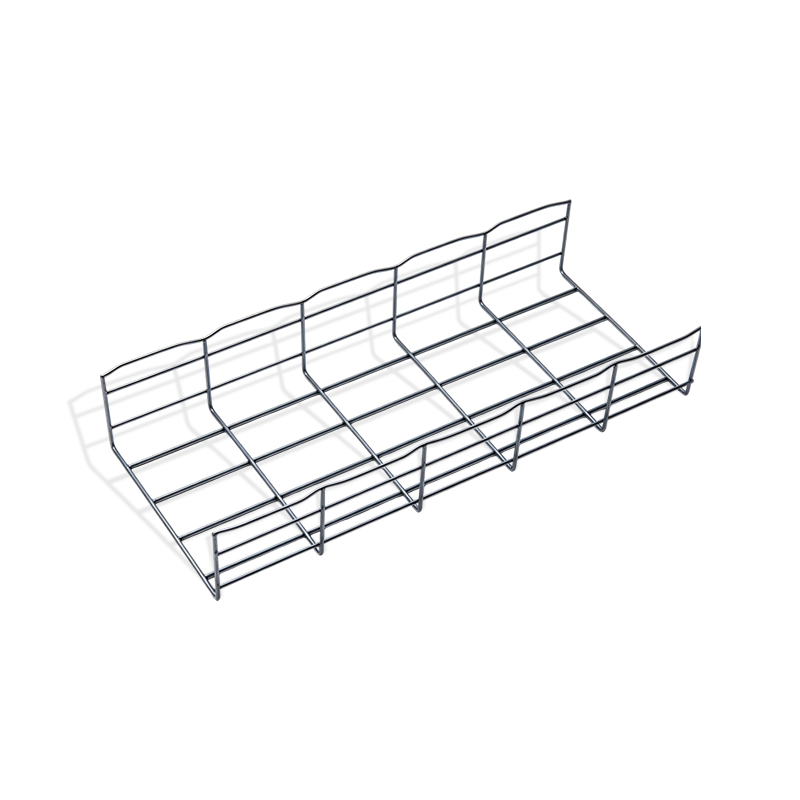
Stainless steel wire mesh cable tray is engineered specifically for heavy-duty industrial cable management. The welded wire grid construction — typically fabricated from 4 mm to 8 mm diameter stainless steel wire — creates a rigid yet lightweight structure that supports large cable bundles across long span distances without deflection or fatigue.
Industries where it is the standard specified solution include:
- Oil and gas refineries and offshore platforms — continuous exposure to salt spray, hydrocarbon vapors, and extreme thermal cycling
- Food and beverage processing — washdown environments requiring hygienic open surfaces that do not trap debris
- Pharmaceutical manufacturing — cleanroom compliance with open-mesh airflow and easy visual inspection
- Chemical plants — resistance to acid, alkali, and solvent atmospheres that destroy galvanized steel within months
- Power generation facilities — high cable density routing in engine halls and substation cable floors
Industry Definition
A stainless steel wire mesh cable tray is a rigid, open-grid support structure fabricated from welded stainless steel wire, designed to route, support, and protect electrical power and data cables in industrial, commercial, and infrastructure installations — offering superior corrosion resistance over painted steel or hot-dip galvanized alternatives.
How Strong Is Wire Mesh Cable Tray Under Real Load Conditions?
Wire mesh cable tray load capacity is determined by wire diameter, grid spacing, tray width, and span between support brackets. Standard commercial grades carry 30 to 75 kg per linear meter; heavy-duty industrial grades reach 150 to 200 kg per linear meter at a 1,500 mm support span.
| Tray Width | Wire Diameter | Span 600 mm | Span 1,500 mm |
| 100 mm | 4 mm | 40 kg/m | 22 kg/m |
| 200 mm | 5 mm | 75 kg/m | 42 kg/m |
| 300 mm | 6 mm | 120 kg/m | 68 kg/m |
| 600 mm | 8 mm | 200 kg/m | 115 kg/m |
Always apply a safety factor of at least 1.5x to calculated load when designing tray runs in dynamic environments subject to vibration, seismic movement, or sudden cable additions during future maintenance.
Performance in Outdoor and Corrosive Environments
Stainless steel wire mesh cable tray in Grade 316 is the definitive solution for outdoor and chemically aggressive installations. The addition of molybdenum in 316 alloy raises its critical pitting temperature to above 60 degrees Celsius, providing resistance to chloride-induced corrosion that eliminates Grade 304 and galvanized steel from coastal or chemical service entirely.
Grade 316 — Outdoor / Corrosive
- Coastal and marine environments with salt spray
- Chemical plant atmospheres — acid and chlorine resistance
- Outdoor exposed rooftop and facade cable routes
- Swimming pool plant rooms and water treatment
Grade 304 — Indoor / Light Exposure
- Internal commercial building cable routes
- Data centers and server room pathways
- Food processing areas with mild washdown
- Pharmaceutical cleanrooms and laboratories
Wire Mesh Cable Tray vs Ladder Cable Tray: Which Is Superior?
Stainless steel wire mesh cable tray outperforms ladder tray across most modern installation criteria, particularly in environments where flexibility, airflow, and installation speed are priorities. Ladder tray retains an advantage only in very high-load, long-span power cable applications with fixed routing.
| Comparison Criteria | Wire Mesh Tray | Ladder Tray |
| Cable airflow and heat dissipation | Excellent — open grid all sides | Good — open top only |
| Installation speed | Fast — bend and cut on site | Slow — requires fittings |
| Direction changes | Field-formed without couplers | Pre-fabricated bends required |
| Cable entry points | Any point along full length | Rung spacing limits entry |
| Weight (self) | Lighter | Heavier |
| Maximum span load | Up to 200 kg/m | Up to 400 kg/m (heavy grade) |
How to Install Stainless Steel Wire Mesh Cable Tray in Commercial Buildings
Installing stainless steel wire mesh cable tray follows a structured sequence from structural planning through cable population. The open wire format gives installers significant on-site flexibility that reduces labor time by 30 to 40% compared to ladder or solid-bottom tray systems.
Plan the cable route and support spacing
Map the full cable route on building drawings. Mark bracket positions at 1,000 to 1,500 mm centres for standard loads, 600 mm centres for heavy cable bundles. Identify all direction changes, risers, and junction points.
Fix wall brackets or trapeze hangers
Install stainless steel wall brackets, ceiling hangers, or trapeze assemblies at marked positions. Use stainless fixings throughout to prevent bimetallic corrosion at contact points with the tray.
Cut and form tray sections on site
Use angle grinders or bolt cutters to cut tray to length. Bend direction changes in place using tray bending tools — no pre-fabricated fittings required for standard angles under 90 degrees.
Join sections and ensure continuity
Connect tray lengths with splice couplers and earth bonding straps. Electrical continuity across all joints is a code requirement — confirm with a continuity tester before cable population.
Populate cables and apply segregation
Lay power, data, and control cables in separate zones or use divider accessories within wide trays. Secure at maximum 600 mm intervals using stainless steel cable ties or nylon ties rated for the installation environment.
Electrical Safety Standards and Compliance
Stainless steel wire mesh cable tray is compliant with all major international electrical installation standards when correctly specified and installed. Compliance is non-negotiable in industrial and commercial projects subject to third-party inspection, insurance certification, or regulated industry oversight.
Key standards governing cable tray selection and installation:
- IEC 61537 — the primary international standard for cable tray and cable ladder systems, covering load testing, classification, and marking requirements
- NEMA VE-1 — North American standard for metal cable tray systems defining load classes, materials, and installation requirements
- BS EN 61537 — the United Kingdom and European adoption of IEC 61537, mandatory for UK building regulations compliance
- NEC Article 392 (NFPA 70) — United States National Electrical Code requirements for cable tray as a wiring method in commercial and industrial facilities
- AS/NZS 4871.6 — Australian and New Zealand standard for cable management systems in industrial applications
Grade 316 stainless steel wire mesh cable tray meets ATEX zone requirements for use in potentially explosive atmospheres when installed with compliant earthing and bonding — a critical specification requirement in oil, gas, and chemical industry projects.
Frequently Asked Questions
What is the difference between stainless steel 304 and 316 wire mesh cable tray?
Grade 304 contains 18% chromium and 8% nickel, offering excellent general corrosion resistance for indoor and light outdoor use. Grade 316 adds 2 to 3% molybdenum, which dramatically improves resistance to chloride pitting and crevice corrosion. Specify 316 for coastal, marine, chemical, and outdoor installations; 304 is sufficient for interior commercial and cleanroom environments.
Can wire mesh cable tray be used for both power and data cables?
Yes, but power and data cables must be segregated within the tray system to prevent electromagnetic interference affecting signal integrity. Use physical dividers, separate tray sections, or maintain a minimum 200 mm separation between high-voltage power cables and structured cabling or instrument signal cables, as required by IEC 61000-5-2 and site-specific EMC management plans.
How is stainless steel wire mesh cable tray earthed and bonded?
Earthing is achieved by connecting the tray system to the building's main earthing point via a dedicated earth conductor, terminated at each tray section join using approved bonding straps or earth tags. Continuity across the full tray run must be verified after installation. Many jurisdictions require the tray system to function as a protective conductor (CPC), which demands minimum conductor cross-section compliance per IEC 60364-5-54.
What maintenance does stainless steel wire mesh cable tray require?
Stainless steel wire mesh cable tray requires minimal maintenance compared to galvanized or painted steel systems. Annual visual inspection for mechanical damage, cable overloading, and fixing integrity is standard practice. In coastal or chemical environments, inspect for chloride-induced surface staining every six months and clean with a dilute citric acid solution or specialist stainless steel cleaner to restore passive oxide layer protection.

Youming Group is a manufacturing group company mainly engaged in the research and development of new high-strength cable tray
Product
- Wire Type Cable Tray Series
- Punched Type Cable Tray Series
- Trough Type Cable Tray Series
- Cable Rack Ladder Series
- Ladder Type Cable Tray Series
- Marine Cable Ladder Tray
- Strut Channel Cable Tray Series
- Accessories
- Fiber Cable Tray/Optic Cable Tray
- Photovoltaic Stents
- Stainless Steel Cable Tray Series
- Aluminum Alloy Cable Tray System
Contact information
-
No.36, Taidong Industrial Zone Shiyan Town, Dongtai City, Jiangsu Province
